THE SHORT ANSWER
A detailed outdoor buying guide for comparing fit, exposure, care, storage and purchase terms, with practical records and questions to ask before paying.
The best outdoor purchase fits the day you actually have
The patio set looks effortless in the photograph. There is space behind every chair, somewhere to put a drink and nothing waiting to be carried back indoors. Your yard comes with a door that swings into the corner, a favorite sunny seat and a cupboard that may already be full. Those details belong at the beginning of the buying decision. Start by choosing a use, measuring the space in use and checking the exact product's care, storage and written warranty information. Then compare candidates against that brief. This guide helps you build that shortlist without pretending there is one best outdoor material or furniture arrangement for every American home. It includes original planning exercises and hypothetical examples, not product tests or documented homeowner projects. You can use it for a dining table, lounge chair or another movable outdoor purchase. Permanent structures, utility-connected equipment and changes to your property need a separate professional and local approval conversation.
Name the moment before you name the product
Picture the ordinary occasion you want to improve. Is it coffee before work, dinner for the household or a place to read while someone else gardens? Choose one lead use and one occasional use. If you mostly eat outside as a pair, a large entertaining arrangement should earn its place rather than become the default. Equally, a tiny table may be frustrating if your regular meal involves serving dishes and several people. Write a sentence that describes the occasion, the number of people and what must be within reach. Add what currently gets in the way. That last detail often makes a shortlist more useful: an awkward route, nowhere to set a plate or cushions that are inconvenient to put away. Let the sentence travel with you when you browse. A beautiful option can still be the wrong answer to the problem you meant to solve. For the wider layout, begin with the Backyard Planning guide linked from your Outdoor Brief.
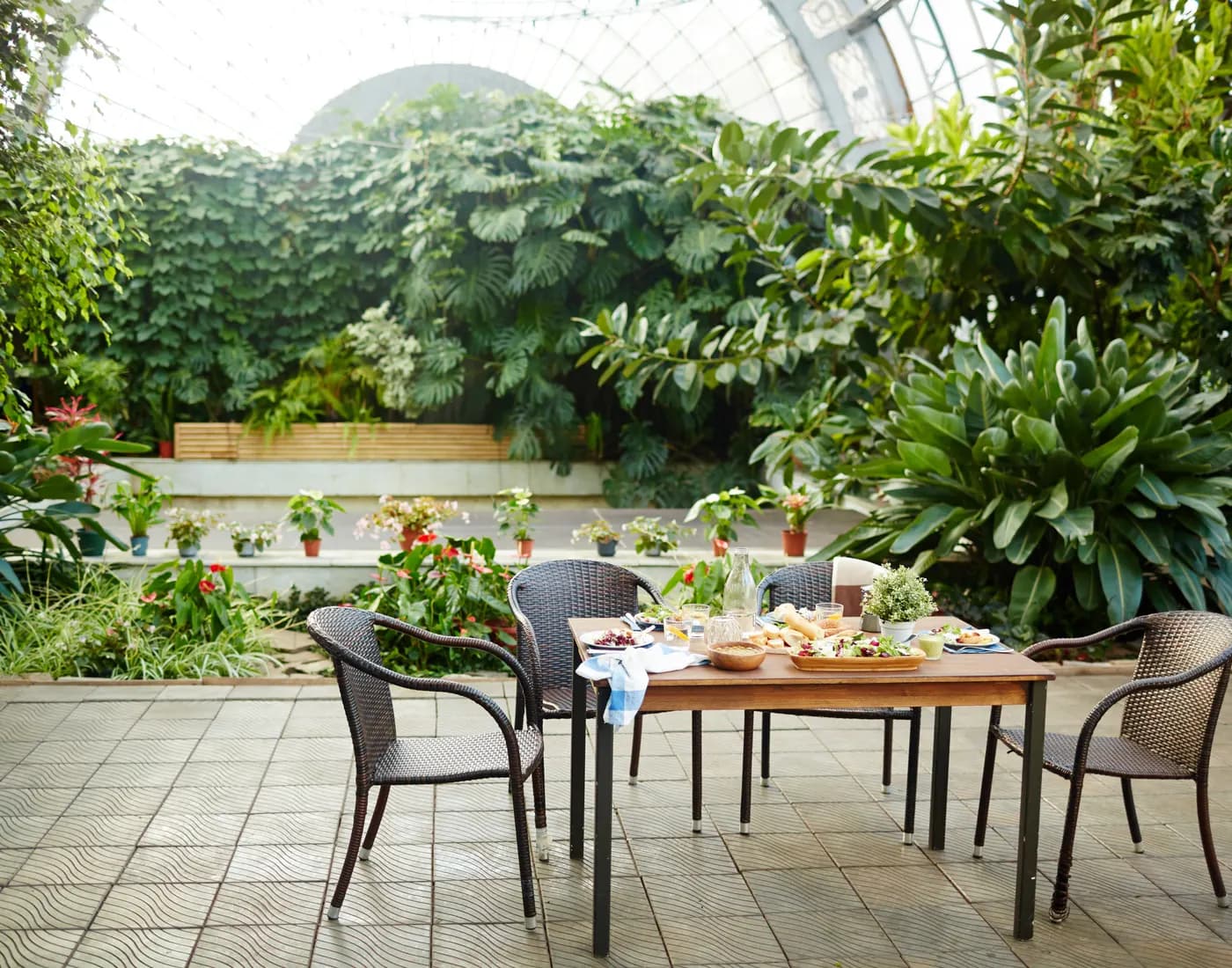
Illustrative design context. Not a construction specification or a documented Yardelia project.
Measure the occupied space, not just the furniture
Record the candidate's width, depth and height from the manufacturer's information for the exact version you are considering. Keep measurements consistently in inches or feet and label them. Then mark a temporary outline in the proposed location using removable markers that will not damage the surface. Add chairs where people would actually sit. Practice pulling them out, standing up, walking to the door and carrying a tray along the usual route. This exercise reveals questions; it does not establish a code-compliant clearance or accessible layout. Avoid borrowing a universal spacing number from an unrelated photograph. Your door, furniture, routes and users are particular to your home. If a route feels awkward in the mock-up, ask whether a smaller footprint, fewer pieces or a different arrangement answers the brief. Have a qualified professional assess accessibility, changes to levels, structural questions and other site constraints. Keep unmeasured areas labeled unknown instead of making the plan look complete.
Try three arrangements before adding another object
An illustrative exercise: a household wants weekday dinners for two and occasional conversation with friends. Sketch a dining-first arrangement, a lounge-first arrangement and a modest combination. In the first, test the dining setup as the main event. In the second, ask whether casual food really works with the seating and surfaces proposed. In the third, check whether two partly furnished zones are less useful than one well-resolved place. None is automatically correct. Compare what each sketch makes easy and what it makes awkward. Count the pieces you would move, the route you would use and the things you would carry outside for an ordinary evening. A compromise that needs constant rearranging may still suit you, but make that choice deliberately. These are hypothetical planning options, not layouts tested at a real Yardelia project. Keep the strongest sketch and the reason it works. Save the alternatives so a persuasive product photograph does not erase the decision you already made.

Illustrative design context. Not a construction specification or a documented Yardelia project.
Let your own sun and shade observations lead
Observe the place at the hours when you expect to use it. Record the date, local time, weather and whether the particular seat or table is in direct sun, filtered light or shade. Keep the observations attached to the location, not to a general description of the yard. A comfortable visit on one fall afternoon does not establish what happens there at summer lunchtime. Mark the seasons and hours you have not observed. The Shade guide provides a fuller observation record and explains how to turn those notes into a question for a qualified local designer or installer. Before buying, ask suppliers whether the exact product is intended for the exposure you describe and where that is documented. Do not turn a broad label into a performance guarantee. If the plan only works after a permanent shade structure is built, treat that as an unresolved project dependency rather than assuming the furniture purchase completes the space.
Compare material questions without inventing a league table
A shortlist becomes confusing when material names stand in for the whole product. Instead of declaring a universal winner, compare the particular construction, finish, intended exposure and instructions supplied for each candidate. Ask what the seller means by the material description and whether it refers to the frame, surface, fasteners, fabric or only one component. Request the care document and any relevant limits for the exact version. Separate what the document says from what you hope the product will do. A question about repairing a finish, replacing a component or moving the piece should remain a question until the supplier answers it. If you can inspect a sample or display model, use that visit to examine the features that matter to you. It does not become a durability, temperature or wet-use test. We have not tested the materials pictured here and do not rank them for lifespan, heat, slip resistance or performance in a particular climate.
Illustrative design context. Not a construction specification or a documented Yardelia project.
A fabric name is a starting point for a care conversation
Identify the actual fabric and its intended application rather than relying on the cushion color or collection name. Ask where the relevant care instructions can be found and whether the cushion assembly has additional guidance. Sunbrella's manufacturer site, for example, separates instructions for upholstery, sling, shade and other applications. That supports checking the relevant category; it does not make one cleaning method suitable for every outdoor textile. Use the exact manufacturer's instructions for your candidate. This guide offers no cleaning mixture, treatment or stain-removal procedure. Think about the task the instructions would add to your week and where you would do it. If you cannot identify the fabric, locate the correct document or understand the seller's answer, keep the candidate in the questions column. A photograph can help you choose a color direction. It cannot tell you the composition, construction or care requirements of the product you are about to receive.
Plan the put-away routine while the shortlist is still small
Choose a plausible storage location and measure it. Include the opening and the route to it, not just the apparent volume inside. Work through the routine with the items you expect to move: cushions, loose accessories, a cover or the piece itself if its instructions call for that. Ask who would do the moving and whether the routine is realistic for that person. Do not assume a folding, stacking or removable part exists because a similar product has one. Verify the actual design and instructions. For a fall or winter planning project, leave seasonal protection requirements to the exact supplier guidance for your conditions. A cover should not be treated as a universal substitute for storage. If the storage plan depends on clearing a space you still need for other things, include that tradeoff in the decision. The useful purchase is the one that has somewhere to go after the attractive outdoor moment ends.
Build a complete purchase scope before comparing prices
You do not need an invented national budget range to compare two real candidates. Make a list of what each offer includes and which items still need a price. Keep the advertised product separate from delivery, assembly, optional components, care items, covers and any preparation of the space. Some lines may not apply; mark them accordingly rather than adding assumed charges. Ask for the actual amounts and terms relevant to your order, including the currency and date checked. Keep unknown amounts visible. Compare equivalent configurations so a table offered alone is not casually compared with a complete setting. If buying a larger arrangement would require altering the yard, get the appropriate site assessment and scope separately. A furniture listing is not a quote for construction, drainage, electrical work or a permanent shade installation. The objective is a clear decision about what you are purchasing today and what remains outside it.
- Included in the offer: record the exact pieces and options.
- Quoted separately: name the item and keep the dated amount with its source.
- Still unknown: write the question and who will answer it.
Read the written coverage before you pay
The FTC's consumer warranty guidance recommends reviewing the coverage period, exclusions, remedy and claims process and retaining the warranty with the purchase receipt. Use those points to organize your questions. Ask which document applies to the exact product and who handles a claim. Record any stated shipping or labor responsibilities instead of assuming they are included. If an answer matters to your decision, get it in writing and keep it with the applicable document. This is a purchasing record, not a legal interpretation of your rights or a promise about how a dispute will be resolved. Where coverage is unclear, ask the seller or manufacturer to identify the relevant wording; seek appropriate consumer or legal advice when needed. A long headline period is not enough information to compare two offers. Read the details that describe what is covered and what the provider says it will do.
Ask how the purchase reaches its final position
Before placing an order, read the delivery and assembly terms for the actual offer. Where does the delivery service stop? Which steps are included? Who is responsible for moving the item into the intended position? Check the access questions you identified during measurement and discuss them with the seller. Record the package or component dimensions when supplied and ask about anything that remains uncertain. Do not use a favorable answer about a different product as proof that this one will pass through your route. Read the current return, cancellation and damage-reporting terms before paying, including the process and any stated costs. This guide does not assume a standard return window or a right to return a changed-mind purchase. If timing affects an event or another contractor's work, distinguish a confirmed commitment from an estimate. Keep the order details somewhere you can find them when the delivery arrives.
Use a small comparison record that makes gaps obvious
Give each serious candidate its own page. Copy the fields below, attach links to the exact listing and documents, and put the date beside each source. The record is deliberately small enough to finish. A product does not become a better choice because you collected more screenshots of it. Focus on the information needed to answer your original use sentence. Compare the records side by side and circle anything you cannot yet establish. Do not award a made-up score to missing information or quietly treat an unknown as zero. If the alternatives serve different purposes, return to the brief before calling one better value. Keep your notes as a personal decision aid; they are not an independent product review or laboratory result. You can repeat the record for a later purchase without forcing every decision into the same style or brand.
- Use and exact model/configuration: __________
- Dimension source, date and your measurements with units: __________
- Observed exposure and unanswered seasonal questions: __________
- Care, cover and storage documents checked: __________
- Included items and remaining quoted/unknown costs: __________
- Written warranty, delivery and return terms checked: __________
- The next question to resolve before deciding: __________
Recognize the point where buying should wait
A shortlist can be complete enough to show that you are not ready to order. That is useful progress. Pause when the candidate only fits an unmeasured space, the care document cannot be matched to the product, or the plan depends on a project that has not been assessed. Pause when a finish, size or included component is still uncertain. A deadline or promotional message does not answer those questions. Instead, identify the smallest next step that would change the decision: a measurement, a written supplier answer or a professional visit for a site issue. Keep browsing if it helps you understand the options, but separate that activity from a purchase commitment. You can also decide to retain what you already own and solve a smaller problem first. A missing side surface or an awkward position may deserve attention before you replace an entire arrangement. No product in the stock photographs is being recommended or offered for sale by Yardelia.
Illustrative design context. Not a construction specification or a documented Yardelia project.
Turn one weekend into a decision you can explain
Start with a short site visit rather than a full shopping session. Write your main use, photograph your own space if helpful and collect the measurements you can establish safely. Make the temporary layout, notice the route and record the exposure at a relevant hour. Next, choose a small number of actual candidates and complete the comparison record. Send the unresolved product questions to the appropriate supplier yourself. When a question involves the property, a structure or utilities, take it to a qualified local professional. Finally, choose between proceeding, changing the shortlist and waiting for a specific answer. You should be able to explain the outcome in a sentence: this option supports our ordinary use, fits the observations and measurements we made, and comes with care and purchase terms we understand. If you cannot say that yet, keep the remaining question visible. The goal is an outdoor space that works on an unremarkable Tuesday as well as in an inspiring photograph.
Questions that often change the shortlist
Should you buy a complete matching set? Consider it if the individual pieces answer your use and fit together in your measured arrangement. Check each component rather than assuming the package solves the layout. Can you choose from photographs alone? Photographs can establish a visual direction, but dimensions, documents and your own site observations need separate checks. Is a material name enough to judge outdoor suitability? Ask about the exact construction, finish, application and supplier instructions; this guide supplies no universal material ranking. Should a sale determine the timing? First establish the configuration and purchase terms you need. A reduced advertised price does not resolve an incomplete scope. What should you do next if the whole layout remains uncertain? Use Your Outdoor Brief to collect the priorities, then read the Backyard Planning and Shade guides for the site questions that belong before the shortlist. Keep technical questions with qualified local professionals rather than turning a shopping worksheet into an installation plan.
Sources & scope
AI-assisted editorial planning guide published by Yardelia, Oryvelon LLC. Substantially rewritten November 1, 2026, with original planning exercises and clearly hypothetical examples. Primary source context and existing Yardelia image licences checked. FTC guidance supports the written-coverage questions; Sunbrella is a manufacturer-specific care example. No independent human expert review, hands-on product test, site inspection, verified price survey or local legal interpretation is claimed. All photographs are licensed illustrative stock imagery, not documented Yardelia projects. No affiliate or paid placement. Original publication timestamp preserved. Yardelia further-reading links support navigation and are not independent source evidence.
FTC: Written warranties and purchase recordsSunbrella: Application-specific care guidanceYardelia further reading: Backyard PlanningYardelia further reading: Shade observation and planningSources checked 2026-11-01 · See preparation method above.
Put the questions into your own brief.
Gather the observations that matter to your space and take them to a qualified local professional.
Create your Outdoor Brief