THE SHORT ANSWER
Compare inground pool quotes on the same scope. Use a checklist for excavation, decking, safety, equipment, and the recurring costs of pool ownership.
Put one finished project on the page
An inground pool quote is comparable only when both builders are pricing the same finished project. Give each builder a dated sketch and the same written brief, then ask them to mark what is included, what has an allowance, and what another contractor must provide. Draw beyond the waterline. Mark the part of the yard you expect to walk on barefoot, the path from the house, the equipment location, and where the crew can enter. Add the areas you expect to get back in usable condition when the trucks leave. Someone standing at the kitchen door should be able to point to every part of the plan and tell whether it belongs to the opening-day project or a future phase. If two bids reference different drawing revisions, send both builders the same version before comparing prices. A smaller pool can be the right trade if the revised plan still leaves room for the way your household actually uses the yard. Ask the builder to show that alternative on a separate line so you can compare it with the original brief.
Walk the route the machinery will take
Ask the builder to show where excavation equipment, trucks, and any lifting equipment will enter, turn, and leave. Write down the assumed access width in feet or inches and ask who verifies that it works for the equipment proposed. Trace the route on the same drawing as the pool. A side gate, steps, a paved driveway, an overhead obstruction, or a neighbor’s boundary can change the plan. Have the builder identify what needs a site visit, survey, utility locating, or other qualified assessment before a price can be firm. Ask for separate responsibility for temporary protection, fence removal and reinstatement, soil hauling and disposal, and repairs along the route. If excavation assumes that soil can be kept on site, ask where it goes and who leaves that area at its final grade. If some material must go off site, find out how the volume is measured and which trips or disposal fees are included. Record the response beside the excavation line. The purpose of the walk is to get the assumptions out of conversation and into the bid.
Read the words below the dollar amount
A fixed line covers the work described under stated assumptions. An allowance sets aside money for a choice or quantity that still needs to be resolved. An exclusion leaves that work outside the bid. Those labels are useful only when the builder explains what they mean in that proposal. For a finish allowance, ask whether the dollars cover material only or also delivery, installation, waste, and tax. For a unit-priced item, write down the included quantity, the price per additional unit, and who measures the final quantity. For a site condition the builder cannot price yet, ask what would trigger a change, how the finding will be documented, and when you will receive a written price for approval.
- Included: Find the referenced drawing, quantity, material, and limits of the work.
- Allowance: Record the dollars, what those dollars buy, and how a credit or overage is calculated.
- Excluded: Name the trade responsible and obtain a price for the same scope where possible.
- Unresolved: Name the missing fact and who will confirm it. Leave its cost open until you have evidence.
Match the pool and its equipment line by line
Compare the pool specification as well as the installation services that make it usable. Start with the dimensions, entry features, interior finish, and coping specified on each plan. Ask the builder to identify equipment by make and model where possible. The word ‘standard’ can hide a difference you can only see when a proposal identifies the pump, filter, controls, and any heater or cover. Ask who supplies, installs, connects, and starts each item and who is responsible for scheduling the trades. A listed heater, for example, tells you little about the scope of the service connection. Ask what runs from the proposed supply point to the equipment and who patches the route after that work. Have appropriately licensed electricians, gas fitters, or plumbers assess those items as applicable in your jurisdiction. Obtain their written scope before accepting a placeholder. Also ask where replacement or service access is planned. You want to be able to tell a technician where to stand and what can be reached once the deck and landscaping are in place.
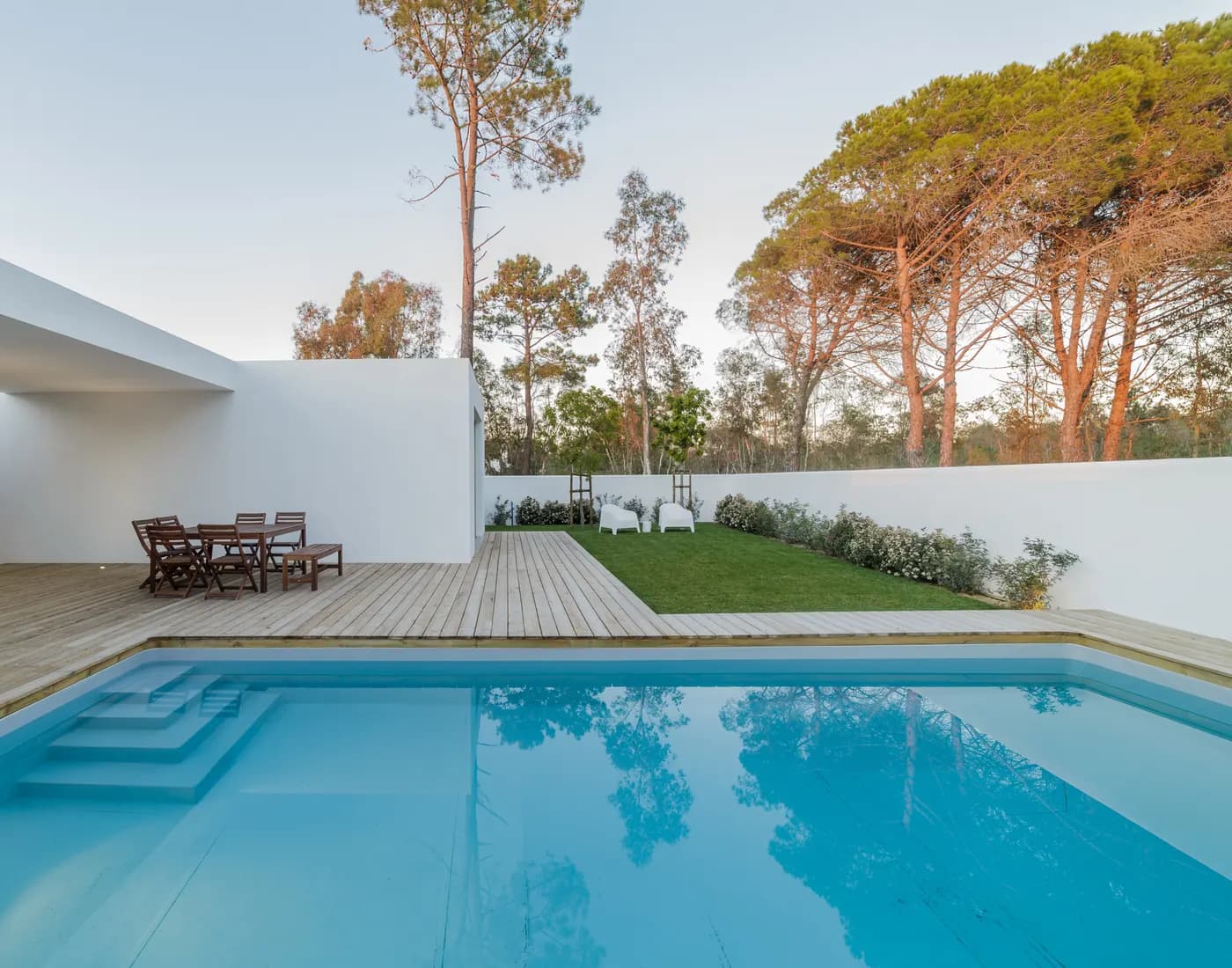
Illustrative design context. Not a construction specification or a documented Yardelia project.
Define the pool deck and the yard you get back
Have both builders measure the deck and describe its boundaries from the same drawing. Deck area in square feet is more useful than a line that reads ‘deck included.’ Ask about surface material, site preparation, edges, steps, and the connection to the house or existing patio. Identify the team responsible for grading and drainage where the new work meets the old yard. Mark landscaping or irrigation that will be disturbed and describe what counts as restored. A cleared bed, fresh soil ready for planting, and reinstalled plants are different deliverables. Take the same approach to fencing and gates that crews may remove for access. If deck and pool work are under separate contracts, ask both contractors to identify the handoff date, the conditions the next crew needs, and who addresses an issue at the joint between the two scopes. Put that responsibility on the drawing or written scope so you can check it during a walkthrough. Our patios and decks guide can help you prepare a separate set of material and maintenance questions.

Illustrative design context. Not a construction specification or a documented Yardelia project.
Put safety and approvals in the opening-day scope
Carry barriers, required approvals, and inspections in the opening-day budget from the beginning. The U.S. Consumer Product Safety Commission’s residential pool barrier guidance treats barriers as one layer of protection alongside close supervision. Ask your local building department what applies to your site and who may carry out each part of the work. Separately, check any homeowners association approval process that applies to your property. Before comparing bids, identify who submits plans, pays fees, schedules inspections, corrects rejected work, and records final approvals. Ask for written responsibility for the barrier, gates, and any related safety equipment the local authority requires. A cover line should name its purpose and model so a qualified pool professional can verify suitability for the intended use. Evaporation control and safety are separate questions. If a builder excludes barrier work, get that work priced and scheduled with the appropriate contractor before deciding the project is ready. Agree on when the pool can be used with the relevant professionals and authorities. Keep required safety work in the first phase if you decide to defer decorative work.
Compare a season of ownership on the same assumptions
Request separate figures for installation, recurring care, and later replacement. Ask what assumptions sit behind any annual estimate, including the months you expect to use the pool, any planned heating schedule, who handles routine service, and the water and energy rates used. The EPA WaterSense residential pool guidance identifies evaporation, leaks, cleaning, and splashing as water-loss routes and discusses covers as one way to reduce evaporation. Ask each builder how the proposed equipment and your intended routine affect the assumptions in their estimate. For a heated pool, use the same intended swim season and water temperature when asking two providers to estimate energy use. Ask for a service quote for the same number of visits and the same included work. If the monthly figure excludes supplies, callouts, or opening and closing visits, give those separate rows. Set aside a place for future resurfacing or replacement discussions based on the exact equipment and finish you choose. Ask which items are covered by warranty, who handles the claim, and which labor or visits you might still pay for.
Ask the climate question that changes your bid
Bring the builder a short description of when you want to swim and what happens to the site in its hardest season. In a cold-winter area, ask how the proposed equipment and warranty handle the off-season and get a written opening and closing scope. In a hot, dry area, ask how water will be supplied for the initial fill and check current rules with the water utility before booking it. If you intend to use a cover, ask where it stores and whether the household is likely to use it after an ordinary swim. In a wet or sloping yard, share photos taken after rain and ask a qualified site professional to identify grading, drainage, or soil questions that need to be resolved before a firm bid. Use the answers to refine the scope and mark each unresolved condition with the name of the person who can assess it. The same pool model can come with a different list of work even two streets apart. A site visit and local written estimates are the starting point for a dollar range you can use.
Example: the cheaper bid has an open handoff
Suppose two fictional builders use the same pool drawing. Builder A’s lower total includes digging and installation but excludes soil disposal and the electrical connection. Builder B includes disposal up to a stated quantity and an electrical connection from a named point. Both provide a deck finish allowance, but only Builder B says what installation is included. The homeowner asks Builder A to price hauling against the same disposal assumption and gets a separate electrician’s quote from the same connection point. They ask both builders for a revision that prices the same deck surface and area. A second walk reveals that fence reinstatement falls outside both bids, so it becomes its own quoted line. Finally, Builder B confirms that rock excavation would be a written change, and Builder A has still to specify how unexpected rock would be handled. At this point the homeowner has comparable known work and a short list of open risks. The quotes might still differ. That difference can now be traced to specific work, assumptions, schedule, or warranty terms. No national average would answer the question that matters here, which is what each builder will deliver at this address.
Use this worksheet before you pick a builder
Create one row per scope item, with a column for each builder. Across the top, record the drawing revision, bid date and expiration, quoted total in USD, and whether tax is included. Within each row, keep quantities and units beside the amounts. Write the name of the person or company that owns any work outside the main contract. The FTC’s home improvement guidance recommends getting written estimates and asking about large differences among them. Use that conversation to request a revised bid you can compare and keep.
- Site access and protection: route, entry width, temporary work, and what must be repaired afterward.
- Excavation and disposal: assumed conditions, included quantity, hauling, fees, and how unexpected work is approved.
- Pool and equipment: exact specification, finish, controls, delivery, installation, connections, and startup.
- Surroundings: deck area in square feet, surface, grading, drainage, barrier scope, and yard restoration.
- Approvals and handover: permit and inspection responsibilities, completion criteria, manuals, service contacts, and warranties.
- Ownership: fill water, heating assumptions, routine care, supplies, seasonal service, and planned replacements.
- At the bottom, keep known included charges, separate written prices, and unpriced items visible. Count each item once. Check whether the quoted total already contains each allowance before replacing it with the price of your selected option.
Find out who comes back if something needs attention
Compare warranty service separately from the warranty term. Ask for the written terms for the pool structure, finish, equipment, and installation, then identify who you call for each. If the installer and equipment manufacturer both offer coverage, ask where a service call starts and who determines which coverage applies. Get any maintenance or recordkeeping conditions in writing and check whether your planned service routine can meet them. A promise on the proposal and a warranty from a manufacturer can have different coverage, so ask the builder to identify which document governs each item. For a split contract, ask how the builder and deck contractor will handle a problem that appears at the edge where their work meets. A joint walkthrough is a chance for both to see the same condition and document it before the next crew covers it. Ask who supplies the model numbers, purchase records, manuals, and contact list at handover. Keep those documents with the approved changes and inspection records so the next owner or service technician can reconstruct the work. Before choosing a bid, try a simple test. Pick one realistic follow-up question, such as who to call if a pump stops during the first swim season, and see if the written proposal gives you a clear route. If it leaves you to choose between two companies, ask the builder to spell out the first contact and the expected next step.
Decide what can wait, then write the handover
If the comparable bids are above your budget, ask for an alternate scope with fewer optional features or a smaller area of decorative hardscape. Have the builder explain how the alternate changes daily use and which future work would require reopening finished surfaces. Keep necessary approvals, barriers, and essential site and utility work in the opening-day scope. Before committing, ask for a written schedule and the milestone that triggers each payment, as well as the process for authorizing changes. Verify licensing where applicable and ask for proof of insurance, as the FTC recommends. Define the handover while the scope is still being negotiated. It can include a walkthrough, records of applicable approvals, equipment and warranty details, startup instructions from the installer, and contacts for follow-up. Capture your three biggest unresolved items in Yardelia’s Outdoor Brief and take the dated drawing and comparison sheet to the next site meeting. Use the pool design guide if you still need to settle where the pool belongs. Use the backyard planning guide if you need to decide how much yard the pool project should take.
Sources & scope
AI-assisted editorial preparation by Yardelia, published by Oryvelon LLC. Federal Trade Commission, EPA WaterSense, and U.S. Consumer Product Safety Commission guidance checked November 6, 2026. The bid comparison is a hypothetical planning example. Obtain dated local bids and qualified site-specific advice for pricing, engineering, installation, and code compliance. Images are licensed stock used for illustration. Source checking is an editorial process.
FTC: How to avoid a home improvement scamEPA WaterSense: Pool water efficiencyCPSC: Safety barrier guidelines for home poolsYardelia: Plan the pool and its surroundingsYardelia: Compare patio and deck materialsYardelia: Define your backyard project scopeYardelia: Create your Outdoor BriefSources checked 2026-11-06 · See preparation method above.
Put the questions into your own brief.
Gather the observations that matter to your space and take them to a qualified local professional.
Create your Outdoor Brief